
Padley Common
What is it?
Padley Common is a relatively small Common that is contiguous with Meldon Common and Nattadon Common. Many streams flow into it from the surrounding hills, making it a naturally damp area which has at times been very rich in wetland-loving vegetation. It is part of a much bigger Common: the Chagford Common, which extends as far as Fernworthy.
The area is owned and managed by Chagford Parish Council, with help from the Chagford Commoners (local farmers who have grazing rights at Padley) and many volunteers.
What might you see or hear at Padley?
Birds
Padley Common, with its Rhos pasture and wet willow woodland, supports a rich variety of birdlife, shaped by damp soils, dense vegetation, and abundant insect life.
Warblers such as willow warblers and chiffchaffs are frequent visitors in spring and summer. Along with blackcap and garden warbler, they fill the area with song.
The dense cover also suits species like wrens, robins, and blackbirds who forage along the woodland floor. Both song thrush and mistle thrush are also heard in spring. Great spotted woodpeckers may be heard drumming on tree trunks, and you may also, on occasion, hear the loud "laugh" or "yaffle" of the green woodpecker.
Around the edges of the gorse and bracken, there may be stonechat; listen for their distinctive call like two pebbles being tapped together.
Seasonal changes bring further variety, with winter visitors such as redwings and fieldfares feeding on berries. Also look out for birds of prey: buzzards can always be seen soaring above the Common, and at night, especially in spring and autumn, listen out for the distinctive hooting of tawny owls.
Adders
The Adder, Vipera Berus, is one of the more reclusive residents of Padley Common.
This protected species emerges from hibernation in early February, to mate in late March. Males emerge first, basking in early spring sunshine, while females emerge a little later. The females give birth to live young in late August.
They shed their skins in March, after which their colouring can range from bright grey for males to a brackeny or even greenish brown for the larger females, both typically with a distinct bold black zigzag pattern along their backs (photos below).
These beautiful, shy creatures are venomous but are not aggressive and will only bite if threatened or provoked. An adder bite can be dangerous for dogs, so you might want to keep yours on a lead.
Should you be lucky enough to see one,
Stand back, Don’t touch, watch quietly.


Rare Butterflies
Marsh Fritillaries, Pearl-Bordered Fritillaries and Small Pearl-Bordered Fritillaries all breed at Padley Common – it's very unusual to find such a combination of endangered butterflies.
Marsh Fritillaries breed in marshy areas, where their only food, a plant called Devil's Bit Scabious, thrives. They are a pretty, orange and black butterfly whose wingspan measures about 4 cm at most. In May they emerge, mate, and the females lay eggs shortly after. From these eggs, tiny caterpillars emerge in late summer and begin feeding on the Scabious plants. They remain in little communal groups, spinning protective webs in between rushes or grasses, and head into dormancy through the winter. In March they emerge and pupate into colourful chrysalises.
They are threatened, not only in the UK, but throughout Europe, and are a high priority for Butterfly Conservation. The main risk is from habitat extinction. At Padley, the widespread growth of trees continually threatens their breeding grounds – butterflies like to fly low and will not risk heading high up into the air to get past trees. And of course their only food – Devils Bit Scabious – needs a particularly marshy ground: trees drain a great deal of moisture from the land and often shade out smaller vegetation. Grazing by local Dartmoor ponies, owned by the Chagford Commoners, helps to maintain the right kind of pasture for them – but see below for a description of what is being done to preserve the area for butterflies, amongst other species.
Pearl-bordered and Small Pearl-Bordered Fritillaries are also endangered throughout the UK and Europe. They emerge earlier in the year, and the photograph below shows the white "pearls" on the underside of their wings. The caterpillars live on Dog Violets which grow along the edges of paths and Bracken – often where there is a mixture of shelter and sunlight.

Vegetation at Padley
In 1948 there would have been many different wetland plants around the streams, and there were virtually no trees, as this black and white aerial photograph shows:

By the 1980s there was still some grazed permanent pasture, some dense bracken, some damp pasture on fairly firm ground, an established but tiny (0.1 ha) Woodland at the northern end, and some oak and ash woodland on the southern end with bluebells.
There was also still a good-sized species-rich mire to the east of the stream. This was about 400 m long and 80 m wide, with many classic mire plants: bog asphodel, cross-leaved heath, Town Hall Clock, Ragged Robin, and Marsh Orchids. There was also a successful population of Marsh Fritillary butterflies.
2026
In the last 40 years, there has been extensive growth of trees in the valley, particularly in the 21st-century. The map below shows vegetation change in the last 75 years. Birch and willow scrub have spread extensively over the wetter parts of the mire. About 80% of the mire to the East of the Stream has been lost to willow. There has also been a concerning degree of encroachment by Bracken and Gorse onto the drier, grassy part of the Common below Meldon Hill.

Why are Trees a Problem?
Although they are a natural development, trees such as birch and willow - if they are not managed - spread extremely rapidly in a wetland. As they do so, they alter the character of the area, partly by draining moisture from the ground and partly by shading out the light so that smaller plants cannot survive. The photographs below show the consequences:

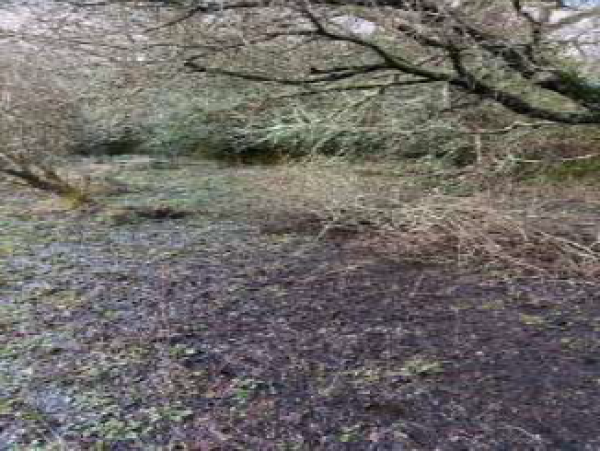

Bog asphodel, Cross-leaved Heath and many other mire plants are either extinct or struggling to hang on. Here a last clump of yellow Flag irises are battling to survive under the new growth of willow:

Butterflies vs Trees
Our rare Marsh Fritillary butterflies need "Rhos pasture" - a tussocky, wet ground where their food plant, Devil's Bit Scabious, thrives. Padley is naturally rich in this ground, and the regular grazing by Dartmoor ponies actually helps to maintain the tussocks in an ideal condition for these butterflies.
Over the last 40 years, however, there has been significant encroachment into the Rhos pasture by trees, which make it impossible for the butterflies to cope. They need a flat, open area in which they can fly close to the ground; they will not fly up 20 feet in order to get past a rapidly developing "hedge" of trees. The photograph below shows how this problem develops, from a scattered few small willows – which quickly become a semi wooded area, completely unsuitable for butterflies.

What is being done at Padley Common?
In the last two years the Parish Council consulted with Devon Wildlife Trust, Natural England, The RSPB, Butterfly Conservation, local Commoners and many others, asking what we should do to best maintain the unique character of this small valley. We are very grateful to people from all these organisations who visited and took the time to share their knowledge and advice.
Based on their recommendations, we have organised several volunteer work parties to start cutting back young willow and birch, in particular around the edges of the scrub, and in the areas where our small population of Marsh Fritillary butterflies breed.
We have placed Boardwalks, with the support of a grant from the Dartmoor National Park, which protect the wet ground from walkers' boots. This makes it possible for visitors to enjoy the area without damaging delicate plants and insects.
The Parish Council has also commissioned surveys of the vegetation and butterflies, so that we can see whether our efforts are making a difference.
The Chagford Commoners work in conjunction with the Parish Council to combat the widespread growth of trees and gorse. Without the cattle and ponies, owned by the Commoners, growth of young trees and molinia grass would never be checked; these livestock are a vital part of our ecosystem.
Plant Survey
As part of the ongoing work on Padley Common, a plant survey was recently undertaken and we are publishing the results here.
Download a copy of the survey (PDF document)